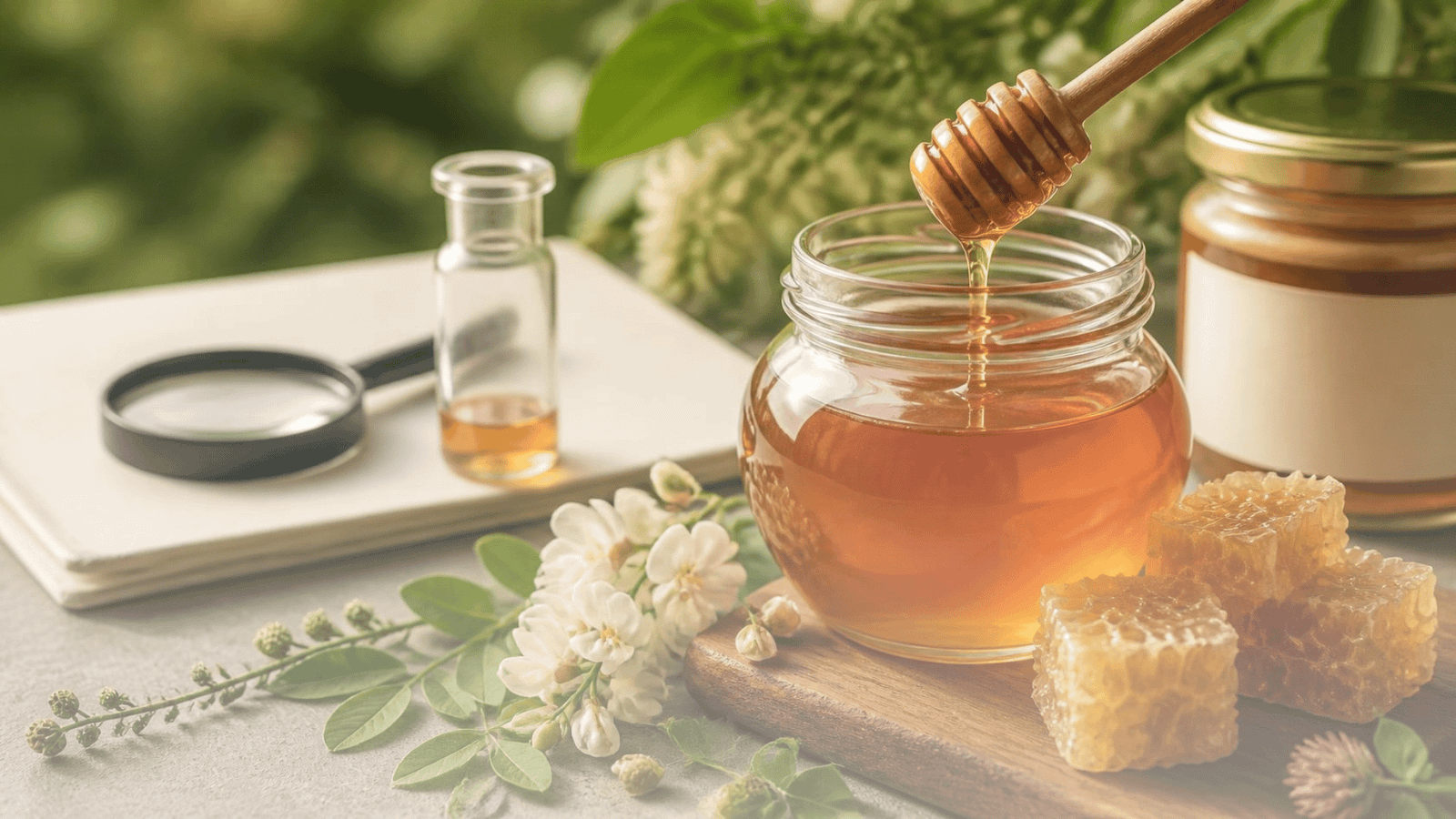
The best honey to buy online in India is one where the seller can tell you the origin, the flower source and the batch, and can show a lab report if you ask. A brand name, a “100% pure” label or a high price does not prove purity on its own. In December 2020, the Centre for Science and Environment (CSE) reported that 77% of the 22 honey samples it tested, from 13 brands, were adulterated with sugar syrup. Most large brands passed the standard purity tests at an Indian lab and still failed the NMR test run in Germany. This guide covers what CSE found, what FSSAI said in response, the checks that help when you shop online, and the home tests that do not work.
What raw honey and processed honey mean
Raw honey usually means honey that has been extracted and strained but not heated much or finely filtered, so it keeps pollen and some enzymes. Processed honey is typically heated to thin it and filtered to a clear, uniform look. Heat can lower the activity of enzymes such as diastase and invertase, and fine filtering removes pollen.
Neither word tells you whether syrup was added. Sellers use “raw” loosely, so ask what it means for the jar you are buying.
What the CSE test found
CSE’s December 2020 investigation tested 22 samples from 13 brands of processed and raw honey. The purity tests ran at the CALF lab at NDDB in Gujarat, and the NMR tests ran at a specialised lab in Germany that CSE did not name. The results:
- 17 of the 22 samples, or 77%, failed at least one test and were judged adulterated with sugar syrup.
- Almost all the large brands passed the Indian purity tests, except one. Several smaller brands failed the C4 test, which detects cane sugar.
- Only three of the 13 brands passed the NMR test.
FSSAI answered in a 3 December 2020 press release. It said NMR was not required at that point because India had no honey database for it, that few regulators worldwide mandate it, and that its own mandatory tests, including a rice syrup marker test, were suitable. It also asked CSE for details of the samples and the methods used.
Two limits apply. The study is six years old, so today’s results may differ, and 22 samples is a small set. Treat it as evidence that adulteration is a real risk, not as a ranking of current brands. The practical lesson is that a honey can pass the standard tests and still be flagged by NMR, and the two sides disagree on whether NMR is needed. A lab report that names the lab, the date and the tests tells you more than the word “pure.”
How to check honey before you buy online
| Check | What a good listing shows | Warning sign |
|---|---|---|
| Label | One ingredient: honey. An FSSAI licence number and a best-before date | “Honey blend,” added flavours, syrup or sugar in the ingredients, no licence number |
| Origin and flower source | A region and a floral source, such as acacia or jamun, and a seller who can explain it | Only “natural honey” with no region or source |
| Batch details | A batch number and a packing or best-before date | No batch information |
| Lab report | A report for that batch that names the lab, the date and the tests, such as C4, rice syrup marker or NMR | The words “lab tested” or a logo with no report |
| Packaging | The material stated, such as glass or food-grade plastic, and an intact seal on delivery | Leaking jar or broken seal |
| Price | A price in line with sellers of the same type of honey | A price far below documented honey of the same type, with no explanation |
About NMR. Nuclear magnetic resonance (NMR) compares a honey’s chemical profile with reference data. It can flag sugar syrups that older tests miss, which is why CSE used it. FSSAI does not require it for honey, so a seller who publishes an NMR report is showing more than the minimum. Ask which lab ran it.
About price. CSE’s NMR failures included large, widely sold brands, so a familiar name or a higher price is not proof. Prices also vary for ordinary reasons. Oasis lists a 500 g jar of Kashmir honey at ₹375 and 500 g of AL-Shifa honey at ₹1,120. Different varieties and origins sit at different prices, so compare like with like. Use price to start questions, not to decide purity.
About returns. Read the seller’s return rules before you order, because opened food packs are rarely returnable. Oasis’s returns and exchanges page asks you to report a wrong, damaged or leaking item within 48 hours of delivery, with photos of the product and the packaging. Check the jar and the seal when the parcel arrives.
The same questions about origin, pack date and sealed packaging apply when you buy nuts. Oasis’s guide on how to choose almonds online in India walks through them.
Why home purity tests do not work
The water drop, flame and thumb tests are widely shared, but none is reliable. Moisture and thickness differ by variety and season, so genuine honey can fail a test, and a well-made syrup blend can pass. CSE’s release also refers to syrups sold as able to beat the standard C3 and C4 tests. Rely on the label, the seller’s documents and a lab report instead.
A sour smell or foam on top is a different signal. It suggests the honey has fermented because it holds too much moisture, and the jar should go back.
Does crystallised honey mean it is fake or spoiled?
No. Crystallised honey is safe to eat. Honey is a concentrated sugar solution, and glucose can separate out as crystals over weeks or months, especially in cool weather. How fast this happens depends on the sugar balance of the honey. Acacia honey stays liquid for a long time, while many wildflower honeys set sooner.
Crystallisation does not prove that honey is genuine or fake, because blends can crystallise too. To liquefy it, stand the closed jar in warm water, not boiling water, and stir. Avoid the microwave, which can overheat the honey.
Honey options at Oasis
Oasis describes its honey as raw, unfiltered and unpasteurised on its honey category page. Prices below were listed on 14 October 2026.
| Product | Options | Price |
|---|---|---|
| Honey 250 gm | 13 varieties, including Sidr, Acacia, Jamun, Lychee, Moringa, Wild Forest and Saffron | ₹290 to ₹510 per 250 g |
| Honey 500 gm | 7 varieties, including Mountain, Litchi, Wild Forest, Jamun and Moringa | ₹460 to ₹750 per 500 g |
| Kashmir Honey 500g | Black Forest or White | ₹375 per 500 g |
| AL-Shifa Honey | 250 g, 500 g and 750 g, imported from Saudi Arabia according to the listing | ₹720, ₹1,120 and ₹1,800 |
For tea and cooking, a mild honey such as acacia is a common pick. Darker forest and Sidr honeys have a stronger taste. You can compare every option on the honey category page, and the checks in the table above apply to any seller, Oasis included.
Storing honey and who should be careful
Keep honey in a sealed jar at room temperature, away from moisture and direct sun. Water getting in is what spoils it, and the fridge speeds up crystallisation.
Do not give honey to a child under 12 months, raw or processed, because of the risk of infant botulism. It is fine for older children and adults. Honey is still sugar, at about 80 g per 100 g according to Oasis’s nutrition table, so people managing diabetes should ask their doctor how much suits them.
FAQs
Which is the best honey to buy online in India?
No single brand or type is best for everyone. Look for a named origin and flower source, batch details and a lab report you can read, in a variety that suits how you use it. A mild honey such as acacia works in tea, and forest or Sidr honeys have a stronger flavour.
Is crystallised honey safe to eat?
Yes. Crystals form as glucose separates out of the honey. Warm the closed jar in warm water and stir to return it to liquid.
Can I test honey purity at home?
Not reliably. Water, flame and thumb tests can mislead, because genuine honey varies and some syrup blends are made to pass standard tests. Check the label, the seller’s documents and a batch lab report instead.
Can babies have honey?
No. Honey, raw or processed, should not be given to children under 12 months because of infant botulism. It is fine for older children and adults.
Does honey expire?
Honey keeps for a long time when it is sealed and kept dry, but follow the best-before date on the label. A sour smell or foam means it has fermented.
Why do honey prices vary so much?
Variety, origin, packaging, brand and pack size all change the price. A very low price for honey sold as single-origin deserves questions, but a high price does not prove purity either, since CSE’s NMR failures included large brands.