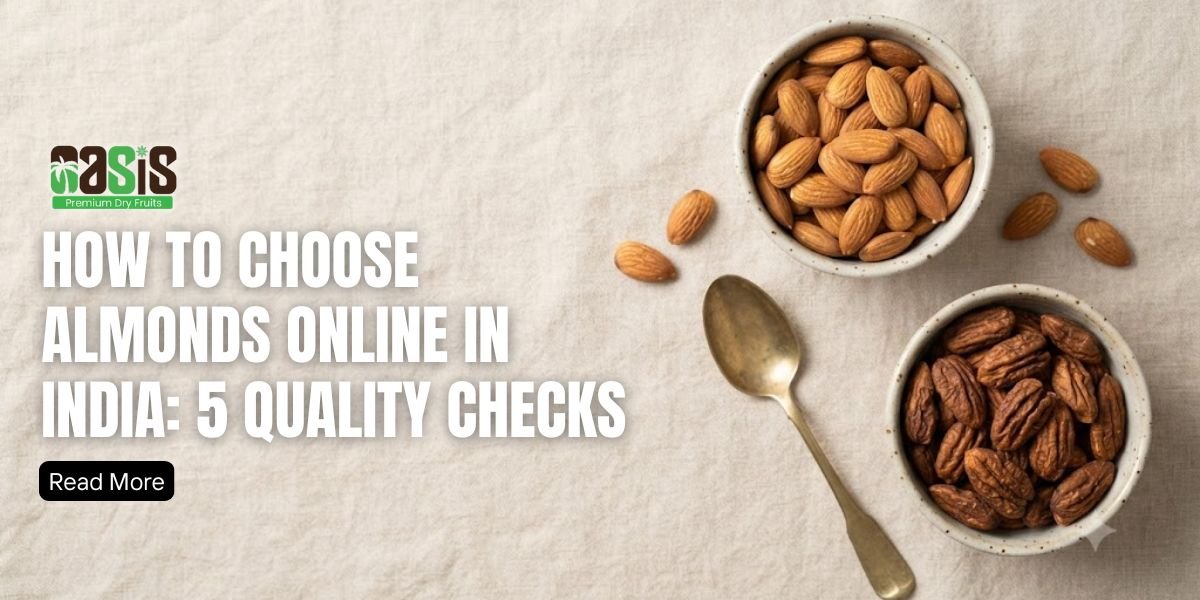
Most people buying almonds online in India are making one decision without realising it. California or Mamra. The problem is that most listings just say “premium almonds,” slap a price on it, and move on. No origin. No grade. No processing details. And because almonds all look roughly similar in a product photo, the quality gap between what you ordered and what arrives is often significant.
This guide gives you five practical checks that work whether you’re standing in a store or scrolling through an online listing at midnight. No fluff. Just the things that actually tell you what you’re getting.
First, Know Which Almond You’re Actually Buying
Before any quality check matters, the variety question needs to be settled. Three types dominate the Indian market and they are genuinely different products, not just different grades of the same thing.
California almonds are what fill every supermarket shelf and most online listings. Large, flat, uniform, machine-harvested and industrially processed. Since 2007, all commercially sold California almonds are required to be pasteurised before sale. We’ll come back to why that matters for the “raw” label in a moment.
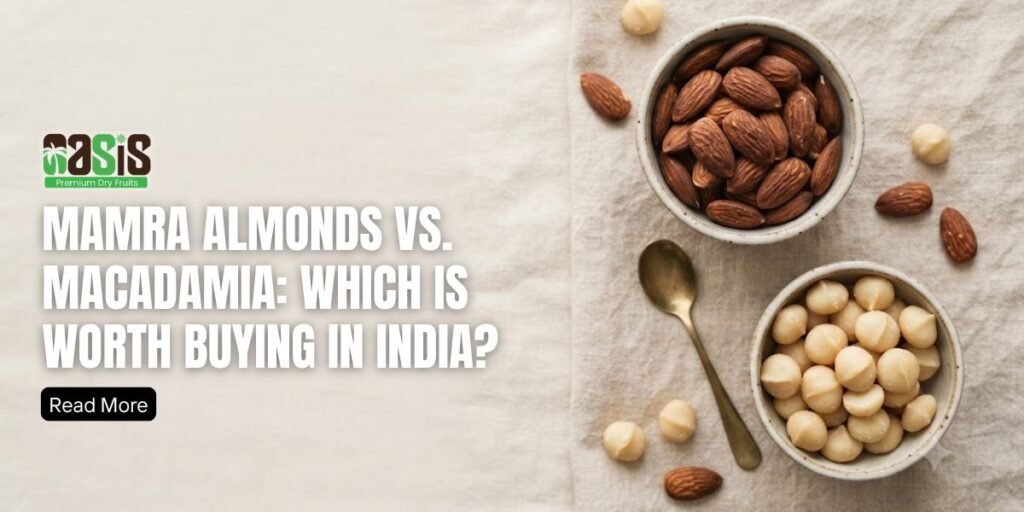
Mamra Badam is the one most Indian households actually want when they say they’re buying premium almonds. Smaller, concave, irregular in shape, and naturally high in oil. Hand-harvested and sun-dried in Iran, Afghanistan, or Kashmir. The oil content sits between 45 and 50 percent, compared to 25 to 30 percent in California almonds. That’s where the nutrition lives, and that’s what you’re paying for.
Within Mamra, the sub-distinction worth knowing is Iranian vs Kashmiri. Iranian Mamra tends to be slightly larger with a rich oil content. Kashmiri Mamra is smaller, more compact, and holds a Government of India GI tag (GI No. 635) confirming its protected origin. Both are good. Kashmiri Mamra is typically priced higher and harder to find in genuine form online.
Gurbandi Badam is the Indian variety, teardrop-shaped, small, thin-skinned, and grown in Afghanistan and parts of North India. Slightly bitter raw but distinct after soaking. Less commonly found online but worth knowing about because sellers sometimes list it interchangeably with Mamra, which it isn’t.
Once you know which variety you want, the five checks below apply within that category.
1. Shape Is the Fastest Check and the Most Skipped One
Authentic Mamra Badam is concave on one side. The kernel curves inward noticeably, and no two pieces look exactly alike. That irregular shape isn’t a defect. It’s the result of natural drying that keeps the oils locked inside the kernel.
If almonds being sold as Mamra are flat on both sides and uniform in shape, they are California almonds. This substitution is common online because most buyers can’t distinguish them from a photo and sellers know it.
For California almonds, the shape check works differently. Uniformity is expected, so what you’re looking for is whether the kernels look plump and full. Overly wrinkled or shrunken California almonds have dried out from poor storage, which means the oils have started to oxidise before you’ve even opened the bag.
2. The Smell Test Tells You More Than the Label Does
A fresh almond smells nutty, faintly sweet, and slightly creamy. With Mamra specifically, there’s an oily richness to it that you don’t get with California. That smell is the fat content announcing itself, and it’s distinctly pleasant.
Rancidity has its own smell. Sharp, slightly sour, with a faint crayon-like edge at the back of the nose. Once you’ve encountered it, you won’t confuse it with anything else. That smell is oxidised fat, meaning the oils have broken down. Eating a rancid almond delivers none of the fat-soluble nutrition and adds oxidative compounds your body doesn’t need.
When your delivery arrives, smell the almonds before eating any. This is the single most reliable quality check you can do at home. Online, since you can’t smell before buying, packaging signals become your proxy (more on that in check five).
3. Weight and the Oil Test: The Two Checks Most People Never Do
Pick up a small handful of almonds. They should feel slightly heavier than you expect for their size. Density indicates moisture retention, and moisture retention indicates freshness. Almonds that feel lighter than they look have dried out more than they should have.
The oil test is specific to Mamra Badam and it’s the most definitive quality check for this variety. Take one almond and press it firmly between your fingers, or break it open. On a fresh, high-quality Mamra, you’ll see a faint sheen of oil on the broken surface almost immediately. Sometimes you can feel it on your fingers without pressing at all. This is what you’re paying a premium for.
If the broken kernel looks dry and chalky with nothing visible, the batch is either not genuine Mamra or has been stored poorly long enough to lose its oil quality. Either way, it’s not worth the price being charged.
4. Read the Label Like It’s Trying to Mislead You (Because Sometimes It Is)
The “raw” problem with California almonds
Since 2007, all commercially sold California almonds must be pasteurised. The US regulation allows two methods: steam processing and propylene oxide (PPO) treatment. Both can legally be labelled “raw.” PPO has been classified as a probable carcinogen by the International Agency for Research on Cancer and is banned in the European Union.
An Indian buyer reading “raw almonds” on a listing has no way of knowing which method was used unless the seller explicitly states steam processing, or the product is certified organic. Certified organic California almonds are exempt from mandatory pasteurisation. If a listing says “raw” without specifying the treatment, it’s worth asking the seller directly.
What “premium” and “natural” actually mean
Nothing verifiable. These are unregulated marketing terms. A listing that says “premium natural almonds” has made no claim you can hold them to. What actually tells you something: origin clearly stated (Iran, Kashmir, Afghanistan, California), grade mentioned (A5 for Mamra, Non-Pareil for California), harvest year or batch date present, and storage conditions mentioned.
Grade claims for Mamra
A5 is the largest and most oil-dense grade of Mamra Badam. Genuine A5 from a reliable seller typically starts around ₹1,200 to ₹1,500 per 250g. If a listing says “Mamra Badam, premium quality” with no grade and a price that seems too reasonable, that’s a signal the seller either doesn’t know or doesn’t want you to know what they’re selling.
5. Packaging Signals Quality Before You Open the Bag
How an almond is stored between harvest and your kitchen determines whether the quality checks above hold up by the time you eat it.
Vacuum-sealed or nitrogen-flushed packaging matters more for Mamra than for any other variety because of its high oil content. Nitrogen flushing removes oxygen from the bag entirely before sealing, which is the best protection available for the delicate volatile oils inside Mamra. A seller who mentions nitrogen flushing is making a deliberate investment in freshness.
Cold storage from the seller’s end matters for Mamra specifically. Temperature-sensitive storage is a different operational standard than room-temperature warehousing, and it shows up in how the almond tastes when you open it.
A batch date or harvest year on the label is the clearest transparency signal of all. Almonds have a shelf life. A seller who tells you when the batch was harvested has nothing to hide about freshness.
Should You Soak Mamra Badam Before Eating?
Yes, and the reason is more specific than “it’s healthier.” The brown skin of almonds contains tannins that inhibit nutrient absorption. Soaking overnight removes those tannins, breaks down phytic acid, and activates enzymes like lipase that help your body digest fat more efficiently. The fat-soluble vitamins and monounsaturated fats in Mamra become significantly more bioavailable when the skin is removed after soaking.
The method is simple. Wash 6 to 8 Mamra almonds in warm water and soak in a clean bowl overnight, 8 to 10 hours is ideal. In the morning, drain the water and discard it. The skin peels off easily when you pinch the almond gently. Eat them on an empty stomach for the best absorption.
One thing worth knowing: with Mamra specifically, the soaking water picks up more than tannins. It also absorbs some of the surface compounds from the oil-rich skin. Always discard it rather than drinking it.
How to Store Almonds So the Quality You Paid for Actually Holds
Mamra Badam’s high oil content makes it more sensitive to heat and air than California almonds. In Indian summer conditions, an open container on the counter is enough to start turning the oils within two weeks. Airtight container, cool and dry location, away from strong-smelling foods. Refrigerate after opening if your home runs warm. Properly stored, Mamra holds for up to three months at room temperature and up to six months refrigerated.
California almonds are more forgiving. Standard cool, dry room temperature storage in an airtight container keeps them good for three to four months without refrigeration.
One habit worth building: buy in smaller quantities more frequently. The freshness at the time you eat it matters more than the price per gram.
The Two Filters That Cut Out Most Bad Purchases
After ordering Badam from multiple sellers over the past couple of years, the variation in quality at similar price points is genuinely surprising. The worst purchases consistently had two things in common: no origin mentioned and loose or poorly sealed packaging. The best ones had the opposite. Origin and grade stated clearly, vacuum or nitrogen-sealed packaging. Filter by those two things before you check price, and the disappointments drop off significantly.
Oasis Dry Fruits lists origin and grade on every almond product, which is the baseline standard every buyer should require before adding anything to cart.
FAQs
Q: Can I tell Mamra Badam apart from California almonds just by looking?
Yes. Mamra is smaller, concave or curved on one side, and irregular in shape with no two kernels looking identical. California almonds are larger, flat on both sides, and uniform because they are machine-harvested. If almonds being sold as Mamra look flat and identical, they are California almonds regardless of what the listing says.
Q: What does “raw” on a California almond label actually mean?
For California almonds sold commercially, “raw” can legally mean steam-processed or treated with propylene oxide (PPO), a chemical classified as a probable carcinogen by the IARC and banned in the EU. Only certified organic California almonds are legally exempt from pasteurisation. For Mamra Badam, raw means genuinely unprocessed with no heat or chemical treatment applied.
Q: Is Mamra Badam worth the higher price?
For daily health use, yes. The oil content, fat-soluble vitamin density, and absorption quality of authentic Mamra A5 justify the price gap over California almonds. For baking or cooking where the almond is a textural ingredient rather than a nutritional one, California almonds are perfectly adequate and considerably more cost-effective.
Q: How long should I soak Mamra Badam?
8 to 10 hours overnight in clean water is ideal. A minimum of 4 to 6 hours still gives meaningful benefit over eating them dry. Drain and discard the soaking water, peel the skin, and eat on an empty stomach in the morning for the best nutrient absorption.
Q: How should I store Mamra Badam at home in India?
Store in an airtight container in a cool, dry place away from strong-smelling foods. If your home gets warm during summer, refrigerate after opening. Mamra holds for up to three months at room temperature and six months refrigerated. Its higher oil content makes it more temperature-sensitive than California almonds, so don’t leave it in open bowls on the counter.