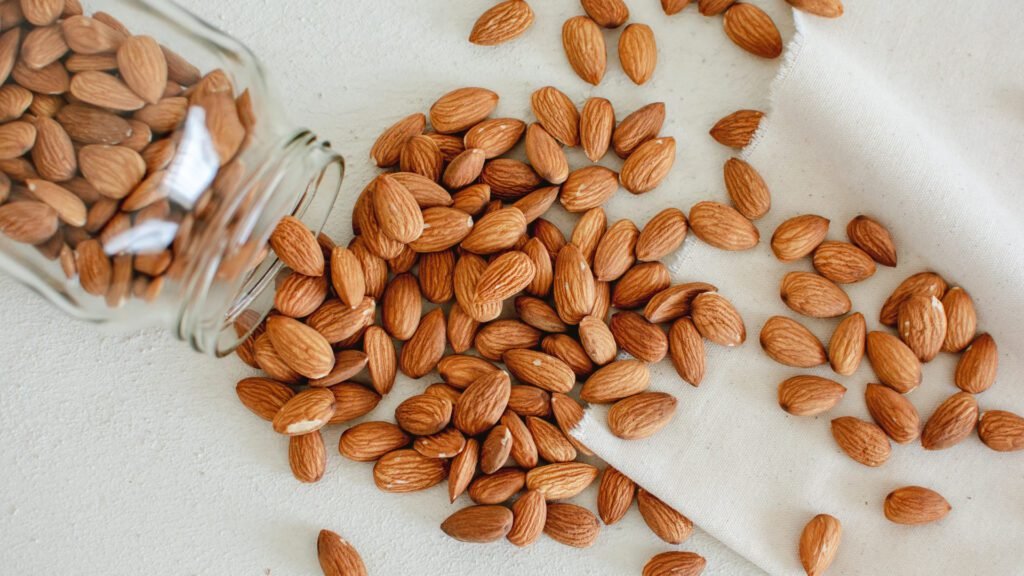
Iran Mamra almonds are a small, curved, oil-rich almond variety grown in cold, rocky regions such as Iran, Afghanistan and Kashmir. Known for their premium price in India, Iran Mamra almonds benefits include nutrients such as vitamin E, magnesium, fibre, protein and unsaturated fat. The strongest evidence for almonds is in heart health. Evidence for better memory or focus is limited, and most research covers almonds in general rather than Mamra specifically. This guide explains Mamra badam nutrition, what research supports, what A1, A3 and A5 grades mean, how to check authenticity and how to eat them.
What are Iran Mamra almonds?
Mamra almonds have smaller, more irregular kernels than California almonds, and each kernel curves inward on one side. “Iran Mamra” refers to Mamra of Iranian origin. Mamra is usually eaten as a daily soaked almond, while California almonds are common in cooking, baking and snacking.
Sellers describe Mamra as oilier and richer in taste. The nutrition panel on Oasis’s Iran Mamra A3 listing shows 49 g of fat per 100 g, close to the roughly 50 g that USDA FoodData Central reports for almonds in general. Mamra’s reputation for oiliness therefore rests mainly on taste and texture, and a lab report for a specific batch is the only way to confirm a measurable difference.
The table below compares Iran Mamra and California almonds on the points that matter when buying.
| Feature | Iran Mamra | California almonds |
|---|---|---|
| Kernel shape | Smaller, irregular, curved inward on one side | Larger, flatter, more uniform |
| Taste and texture | Described as oilier and richer | Milder |
| Common use | Daily eating, usually soaked | Cooking, baking, snacking |
| Price | Higher | Lower |
California almonds are the usual choice for baking, where the price gap adds up across larger quantities.
What do Mamra grades such as A1, A3 and A5 mean?
A1, A3 and A5 are trade labels that sellers use for kernel size and sorting. They are seller-defined labels rather than a nutrition standard, and the scale can differ from one supplier to another. A grade indicates roughly how large the kernels are. It does not show how much vitamin E or oil a batch contains, and only a lab report for that batch can do that.
When comparing listings, check that the grade and origin are stated, and compare the price per 100 g rather than the grade letter alone. A listing that says only “Mamra badam” with no grade, origin or pack date gives you very little to compare.
Nutrition in Mamra almonds
A 30 g serving of almonds provides about 175 to 180 kcal, 6 g of protein, 3 to 4 g of fibre, around 7 to 8 mg of vitamin E and roughly 80 mg of magnesium. The values below are USDA FoodData Central figures for almonds in general and are not specific to Mamra.
| Nutrient | Per 100 g | Per 30 g |
|---|---|---|
| Energy | About 575 to 600 kcal | About 175 to 180 kcal |
| Fat | About 50 g | About 15 g |
| Protein | About 21 g | About 6 g |
| Fibre | About 11 to 12 g | About 3 to 4 g |
| Vitamin E | About 25 mg | About 7.5 mg |
| Magnesium | About 260 to 270 mg | About 80 mg |
Most of the fat in almonds is monounsaturated (oleic acid), with some omega-6 linoleic acid. Almonds contain almost no omega-3, which comes mainly from walnuts, flaxseed and fish.
Heart health: the best-supported benefit
Heart health is the area with the strongest evidence for almonds. In 2003 the US FDA allowed a qualified health claim for almonds and some other nuts: eating 1.5 ounces (about 42 g) a day, as part of a diet low in saturated fat and cholesterol, may reduce the risk of heart disease. The FDA described the evidence as suggestive but not conclusive.
A review of almond research summarised by the American Society for Nutrition found support for almonds’ heart-healthy reputation. The trials it covered used anywhere from 25 to 100 g of almonds a day, so the best amount is still unclear, and the summary describes the conclusions as somewhat tentative. These studies tested almonds in general rather than Mamra.
Brain health: what the evidence supports
Almonds supply nutrients the brain uses, but direct evidence that they improve memory or focus in healthy adults is limited.
Vitamin E and oxidative stress
Vitamin E is a fat-soluble antioxidant, and almonds are a good source: 30 g provides roughly 7 to 8 mg. The brain has a high fat content, and fats in cell membranes are vulnerable to oxidative damage. Vitamin E helps protect them. Eating almonds adds to your vitamin E intake, but it does not guarantee better memory.
Fatty acids and nerve cells
Myelin, the sheath around nerve fibres, is largely fat, and brain cells draw on dietary fatty acids. Almonds supply mostly monounsaturated and omega-6 fats. For omega-3, walnuts, flaxseed and fish are the better sources.
Magnesium
Magnesium takes part in nerve and muscle function, and 30 g of almonds provides about 80 mg. Almonds can contribute to magnesium intake. They do not treat stress, anxiety or poor sleep.
Other benefits of Mamra almonds
- Blood sugar: Fibre, protein and fat slow digestion, so almonds raise blood glucose less than refined snacks. People with diabetes should follow their doctor’s advice on food and medication. Almonds do not replace medicine.
- Bones: Almonds contain calcium, magnesium and phosphorus, which are all part of bone mineral. They add to your intake but do not replace main calcium sources such as milk, curd or ragi.
- Skin and hair: Vitamin E is part of the skin’s antioxidant defences, and almonds add to intake. Evidence that eating almonds visibly changes skin or hair is limited.
- Children: Almonds supply fats, protein and minerals useful in a child’s diet. Whole almonds are a choking risk for children under five, so give almond powder or paste instead. If there is a family history of nut allergy, check with a paediatrician first.
How to check if Mamra almonds are genuine
No single visual check proves that an almond is genuine Mamra. These five signs together make it easier to spot California almonds sold under the Mamra name.
- Shape: Mamra kernels curve inward on one side. California almonds are usually flatter.
- Size: Mamra kernels are smaller and uneven. A pack of large, near-identical almonds is more likely to be California.
- Oil: A fresh Mamra kernel often leaves an oily film when you press or break it.
- Smell and taste: Fresh almonds smell nutty and taste slightly sweet. Rancid almonds smell sharp or sour and taste bitter, so do not eat them.
- Label and price: Look for origin, grade, pack date and the FSSAI licence number. A Mamra listing priced close to ordinary almonds deserves questions.
These signs are guides, not lab tests. The most reliable check is the seller’s origin and batch documentation. Oasis’s guide to choosing almonds online in India covers the buying checks in more detail.
How to eat Mamra almonds
Many households eat 5 to 8 soaked almonds each morning. Almond trials have used 25 to 100 g a day, so that household portion is on the lower side. A 30 g handful adds about 175 to 180 kcal, which matters if you are managing your weight.
Soaking and peeling. Soaking overnight softens the skin, makes peeling easy and gives a softer texture. Evidence that soaking or peeling improves mineral absorption is limited, and the skin carries fibre and polyphenols, so unpeeled almonds are also a good choice. Oasis’s guide to soaked dry fruits benefits explains the method.
Timing and pairing. Any time of day works. Many people eat them in the morning, alone or with warm milk, as a matter of habit rather than a requirement.
Soaked almonds. Soak in clean water, and keep the bowl in the fridge if you soak for more than a few hours in warm weather. Discard the soaking water and eat the almonds the same day.
Dry storage. Keep Mamra in an airtight container in a cool, dry place, and refrigerate in hot weather. Smell a few almonds before eating, because a sharp or sour smell means the oil has gone rancid.
Who should limit almonds
- Tree nut allergy: Almonds can cause severe reactions in people with tree nut allergy. Avoid them and seek medical advice.
- Kidney stone history: Almonds are high in oxalate, and people who form calcium oxalate stones are often advised to limit them. Ask your doctor.
- Weight management: Almonds are energy-dense, so measure portions.
Where to buy Iran Mamra almonds in India
Oasis Dry Fruits lists Iran Mamra in A1 and A3 grades. Iran Mamra A3 comes in 250 g and 500 g packs, priced at ₹1,275 and ₹2,525 as of 14 October 2026. Free shipping applies on orders above ₹799, and delivery usually takes 3 to 7 business days depending on your pin code. In Bengaluru, you can look at the almonds before buying at the Gunjur and Thubarahalli stores. The wider nuts range includes pistachios, walnuts and other nuts.
FAQs
What makes Iran Mamra almonds different from California almonds?
Mamra almonds are smaller, curved on one side and irregular in size, while California almonds are larger, flatter and more uniform. Sellers describe mamra as oilier and richer in taste. Nutrition panels for both show fat at roughly 49 to 51 g per 100 g, so the clearest differences are shape, taste and price.
How many mamra almonds should I eat a day?
Many households eat 5 to 8 soaked almonds. Research on almonds has used 25 to 100 g a day. A 30 g handful is a common portion and adds about 175 to 180 kcal.
Do Mamra almonds improve memory?
Evidence is limited. Almonds provide vitamin E and magnesium, which the body uses for nerve and brain function, but studies showing better memory or focus in healthy adults are limited, and mamra has not been tested separately. Treat almonds as part of a balanced diet rather than a memory treatment.
Do I need to peel mamra almonds after soaking?
No. Peeling is traditional and gives a softer texture. Evidence that peeling improves mineral absorption is limited, and the skin carries fibre and polyphenols.
How do I know if mamra almonds are genuine?
Check the shape (curved inward on one side), the size (small and uneven), the oil (a film when broken), the smell and the label details such as origin, grade, pack date and FSSAI licence number. No single check is conclusive, so ask the seller for origin and batch documentation.
Can pregnant women eat mamra almonds?
Almonds are commonly eaten during pregnancy by women who have no nut allergy. Amounts depend on overall calorie needs, so ask your doctor or dietitian how many to eat.
Can children eat mamra almonds?
Children under five should not be given whole almonds because of the choking risk. Almond powder or paste is a safer form. Check with a paediatrician first if there is a family history of nut allergy.