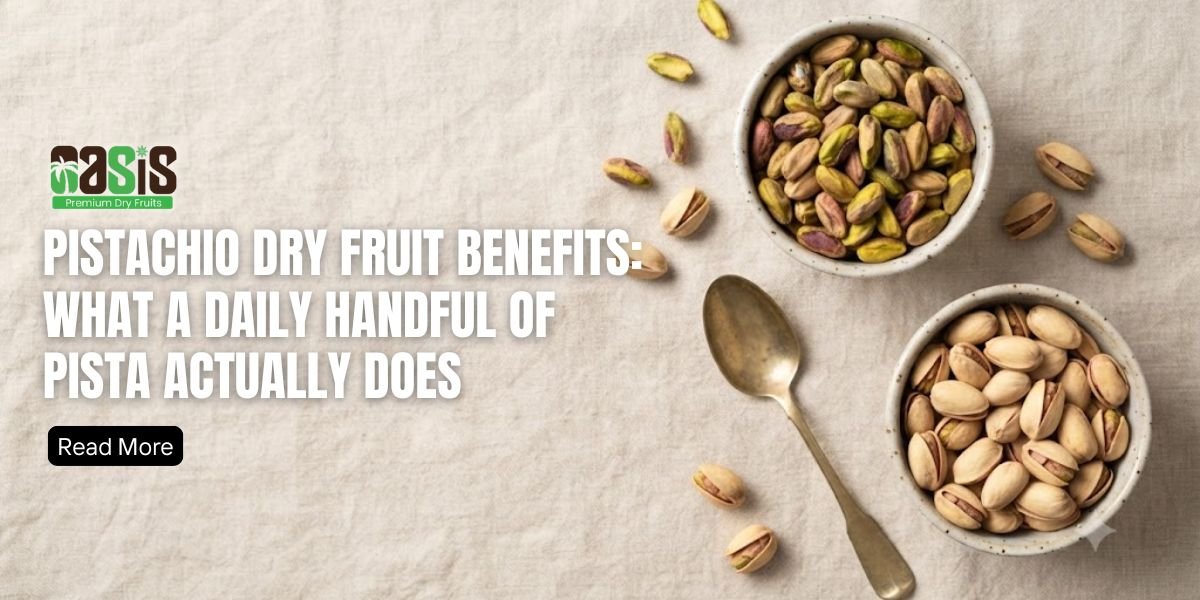
Pista has always been the garnish nut. It goes on top of the kheer, gets pressed into the barfi, and sits in the corner of the mithai box looking decorative. What it almost never gets credit for is being one of the most nutritionally dense dry fruits in the Indian kitchen, and genuinely useful in ways most people haven’t thought about.
The pistachio dry fruit benefits that show up in nutrition research are not small. More Vitamin B6 than almost any other food. More copper than most people get from their entire diet in a single day. Melatonin levels high enough to meaningfully affect sleep. A complete amino acid profile that fills a real gap in vegetarian diets. And now, a body of clinical research done specifically on Asian Indian adults, not Western populations, showing measurable effects on blood sugar management.
The garnish on the kheer deserves a proper look.
What’s Actually in a Handful of Pista
The numbers are more impressive than most people expect. A small handful of around 49 pistachios, roughly 28 grams, gives you:
- Vitamin B6: 28% of the daily requirement, higher than beef, chicken, or bananas
- Copper: 41% of the daily requirement, one of the highest concentrations in any common food
- Thiamine (B1): 21% of the daily requirement
- Protein: 6 grams, with all nine essential amino acids
- Fibre: 3 grams, both soluble and prebiotic
- Potassium: more than half a large banana in the same serving
- Healthy fats: predominantly monounsaturated and polyunsaturated, the same fat profile as olive oil
- Antioxidants: lutein, zeaxanthin, and polyphenols among the highest of any nut
The copper figure is the one most people miss. 41% of what your body needs in a single small serving. The implications of that go well beyond basic nutrition.
The Brain Benefits That Don’t Get Enough Attention
Vitamin B6 and Your Neurotransmitters
Vitamin B6 is directly involved in producing serotonin, dopamine, and GABA, the three neurotransmitters most responsible for mood stability, motivation, and anxiety management. When B6 drops, production of all three falls with it. The result tends to show up as low mood, poor motivation, difficulty sleeping, and a vague mental flatness that people often attribute to stress rather than nutrition.
Pista has more B6 than almost anything else people commonly eat. For vegetarian households, it’s one of the most efficient dietary sources available. A regular daily handful maintains B6 at a level that supports stable neurotransmitter function quietly, without requiring supplements or major dietary changes.
Copper and Neurological Function
Copper is involved in the myelin sheath, the protective coating around nerve fibres that determines how fast and cleanly nerve signals travel. Low copper leads to slowed neural transmission, persistent fatigue, and, in chronic cases, neurological symptoms that frequently get misdiagnosed as something else. Most people in India don’t actively think about copper intake because it doesn’t get the attention iron and calcium do. At 41% of the daily requirement per handful, Pista is one of the most accessible dietary sources of copper in the entire dry fruit category.
Melatonin and Sleep Quality
This is the one that surprises people. Pistachios have among the highest natural melatonin concentrations of any food, significantly more than most other nuts, grains, or fruits. Melatonin is the hormone that regulates sleep-wake cycles. It doesn’t sedate you the way a sleeping tablet does. What it does is signal to the body that it’s time to wind down.
Eating a small handful of unsalted Pista in the evening, an hour or two before bed, can contribute to faster sleep onset and better deep sleep over time. Not dramatically. Consistently. It’s food, not a supplement, but the melatonin content is real enough to be worth building into an evening routine.
Heart Health: Three Mechanisms, Not Just Cholesterol
Most articles reduce Pista’s heart benefits to cholesterol management. The full picture is more specific than that.
Cholesterol and blood lipids: The monounsaturated and polyunsaturated fats in pistachios actively lower LDL while supporting HDL. Multiple research reviews have found pistachios reduce total and LDL cholesterol more consistently than most other nuts.
Blood pressure: Pistachios lower blood pressure through two separate pathways simultaneously. Potassium counteracts sodium’s pressure-raising effect on blood vessels. L-arginine, an amino acid in pistachios, converts to nitric oxide in the body, which causes blood vessels to relax and widen. That vasodilation is a structural effect, not just a dietary one.
Endothelial function: The inner lining of blood vessels, the endothelium, needs to remain flexible to work properly. Stiffened endothelium is an early cardiovascular risk marker that shows up well before cholesterol becomes a problem. A study published in the American Journal of Clinical Nutrition involving 42 adults who ate 40 grams of pistachios daily for three months found measurable improvements in vascular stiffness. A change in snack habit with a structural effect on how blood vessels behave.
Pista and Blood Sugar: The Indian-Specific Research
India carries one of the highest burdens of type 2 diabetes in the world, and prediabetes rates are significant. What makes this relevant to pistachios is that a 12-week randomised controlled trial published in the Journal of Nutrition, conducted specifically on Asian Indian adults with prediabetes at the Madras Diabetes Research Foundation, found meaningful results.
The study involved 120 participants with prediabetes. The intervention group ate 60 grams of unsalted roasted pistachios daily, 30 grams before breakfast and 30 grams before dinner, for 12 weeks. Those in the pistachio group showed a significant decrease in HbA1c, a long-term measure of blood glucose control, as well as reductions in serum triglycerides and waist circumference.
Pistachios have a low glycaemic index, meaning they cause a slow and steady rise in blood glucose rather than a spike. The fibre and protein in pistachios slow digestion and glucose absorption, and research published in The Review of Diabetic Studies found that eating pistachios alongside high-carbohydrate foods reduced the post-meal blood glucose response. Tap Health
For anyone managing blood sugar or with a family history of diabetes, unsalted Pista before meals is one of the more practical and well-researched dietary adjustments available.
Weight Management: The Pistachio Shell Effect
There’s a counterintuitive finding in the weight management research that applies specifically to in-shell pistachios. Two studies found that participants ate fewer calories and felt greater satiety when consuming pistachios in the shell compared to shelled kernels alone. Researchers suggest the physical act of shelling slows the eating process, and the visual cue of empty shells left in sight may signal to the brain to stop eating. American Pistachio Growers
One study found that when pistachio shells were removed from sight, subjects ate 18% more than when the shells remained visible. ScienceDirect
Beyond the shell effect, pistachios are genuinely satiating because of their protein, fibre, and fat combination. A meta-analysis of 33 clinical nut-feeding studies reported in the American Journal of Clinical Nutrition found that nuts, including pistachios, did not increase body weight, waist circumference, or BMI. For a calorie-dense food, that’s a consistently supported finding across large population studies. American Pistachio Growers
If you buy in-shell Pista, keep the shells visible while you’re eating. That simple habit has research behind it.
Skin: The Benefit Hidden in the Nutrient Table
Lutein and zeaxanthin are antioxidants most people associate with eye health. What the same research confirms is that these compounds also protect skin from UV-related oxidative damage. The mechanism is the same whether it’s working in the retina or in the skin’s outer layers: consistent dietary intake builds up in tissue and reduces the rate of UV-induced cell damage that causes premature ageing, dark spots, and loss of skin elasticity.
Copper matters for skin too. It’s involved in collagen cross-linking, the process that gives skin its structural firmness and resilience. Without adequate copper, collagen fibres form but don’t bind as effectively, which affects how skin holds its shape over time. A daily handful of pistachios is one of the most practical ways to maintain copper levels without supplementation.
Pista as a Complete Protein: Why It Matters for Indian Households
A complete protein contains all nine essential amino acids the body cannot produce on its own. Most plant sources are incomplete. Pista covers all nine in a single serving.
For the significant portion of Indian households that are fully or partially vegetarian, this is not a minor nutritional point. Getting complete protein from plants usually requires deliberate food combining, like dal with rice. Pista provides it in a snack with no preparation required. For growing children, elderly family members, and anyone managing protein intake on a vegetarian diet, that completeness has real daily value.
What to Watch Out For: Honest Caveats
Salted roasted Pista is a different product. Unsalted Pista has roughly 1 milligram of sodium per serving. Dry-roasted salted Pista can carry over 500 milligrams. If you’re eating Pista for heart or blood pressure benefits while buying the heavily salted variety, you’re working against yourself. Buy unsalted, every time.
IBS and FODMAP sensitivity. Pistachios contain fructans, a carbohydrate that ferments rapidly in the gut. People with irritable bowel syndrome or diagnosed fructan intolerance can experience bloating, cramping, and nausea from Pista even in small amounts. If Pista consistently causes digestive discomfort, fructans are almost certainly the reason.
Quantity has a ceiling. 30 to 40 grams daily covers the meaningful nutritional range. The benefits don’t compound linearly beyond that. More Pista means more calories without proportional gain.
My Experience with Pista
I used to eat Pista the way most people do, a few from the mithai box at Eid, a handful at someone else’s house, never deliberately. Started keeping unsalted Iranian Pista as a dedicated evening snack about a year ago, partly because of the low calorie-to-satiety ratio, partly because I’d come across the melatonin research.
The sleep improvement was the first thing I noticed. Not dramatic, but consistent. Falling asleep faster on evenings when I’d had Pista than on ones when I hadn’t. The skin change I noticed several months later and didn’t connect to the Pista until I came across the lutein and copper research. Nothing dramatic. Just a general improvement in how the skin looked around the jaw and temples. The kind of thing you notice in hindsight rather than in the moment.
How Pista Fits in the Indian Kitchen
The garnish role is real. Pista in sheer khurma at Eid, the green against the white milk. Biryani finished with fried Pista and Kaju. Pista kulfi, halwa, barfi. These are not health foods in the clinical sense, the added sugar and ghee offset some of the nutritional value. But the Pista itself is contributing real nutrition even inside a dessert.
The daily use is simpler. A small bowl of unsalted Pista on the counter, eaten as an evening snack before reaching for something processed. No soaking, no preparation, nothing to remember except to buy unsalted and keep the shells visible if you’re buying in-shell.
Conclusion
The pistachio dry fruit benefits that matter most are the ones that don’t make it onto the packet. The Vitamin B6 that keeps neurotransmitters functioning. The copper that builds myelin and collagen. The melatonin that helps evenings settle into sleep. The complete amino acid profile that fills a genuine gap in vegetarian diets. And now, clinical evidence from an Indian research institution showing measurable blood sugar improvements in Asian Indian adults specifically.
30 to 40 grams of unsalted Pista daily, evening is ideal for the melatonin effect, covers more nutritional ground than the garnish reputation suggests. Oasis Dry Fruits carries unsalted Iranian Pista sourced for quality and freshness, which is where the difference in flavour and nutrient density actually starts.
FAQs
Q1: How many pistachios should I eat per day?
30 to 40 grams daily, roughly 49 to 60 nuts, is where the nutritional benefits land without adding unnecessary calories. Beyond this amount, the nutrients don’t compound proportionally, you’re mostly adding calorie load. Eating this quantity consistently every day covers meaningful ground on Vitamin B6, copper, potassium, melatonin, and healthy fats without pushing daily intake into surplus.
Q2: Are pistachios good for the brain?
Yes, through three specific mechanisms. Vitamin B6 directly supports the production of serotonin, dopamine, and GABA, the neurotransmitters that regulate mood, motivation, and anxiety. Copper maintains the myelin sheath around nerve fibres that controls signal transmission speed and efficiency. The melatonin content supports deep sleep quality, which is when memory consolidation and neural repair happen. All three work together with daily consistent intake.
Q3: Can pistachios help with sleep?
Pistachios carry one of the highest natural melatonin concentrations of any food. Melatonin is the hormone that signals to the body that it’s time to wind down, not a sedative, but a biological cue. Eating a small handful of unsalted Pista an hour or two before bed can improve how quickly you fall asleep and the quality of deep sleep over time. The effect builds gradually with a consistent daily habit rather than appearing overnight.
Q4: Is pista good for diabetics?
Yes, and there’s Indian-specific research supporting this. A 12-week randomised controlled trial conducted at the Madras Diabetes Research Foundation on Asian Indian adults with prediabetes found that eating 60 grams of unsalted pistachios daily, split before breakfast and dinner, significantly reduced HbA1c and triglyceride levels. Pistachios have a low glycaemic index and the fibre and protein content slows glucose absorption after meals. Unsalted only, and consult your doctor for personalised guidance.
Q5: Should I buy salted or unsalted pistachios?
Unsalted, without exception, if you’re eating Pista for health reasons. Salted roasted pistachios can carry over 500 milligrams of sodium per serving, which directly counteracts the blood pressure benefits the potassium and L-arginine in the nut would otherwise provide. For any daily health-focused consumption, only unsalted delivers what the research actually supports. The flavour difference takes a few days to adjust to and then you stop noticing it.