
The benefits of Ajwa dates fall into two groups: religious and nutritional. Ajwa is a small, dark date from the Madinah region of Saudi Arabia, and Muslims value it because a hadith in Sahih al-Bukhari recommends eating seven Ajwa dates in the morning. Nutritionally, Ajwa provides quick energy, fibre and potassium in the same way as other dates. Research on Ajwa’s own effects comes mostly from laboratory and animal studies, and the few human trials are small, so health claims beyond basic nutrition are not established.
What Are Ajwa Dates?
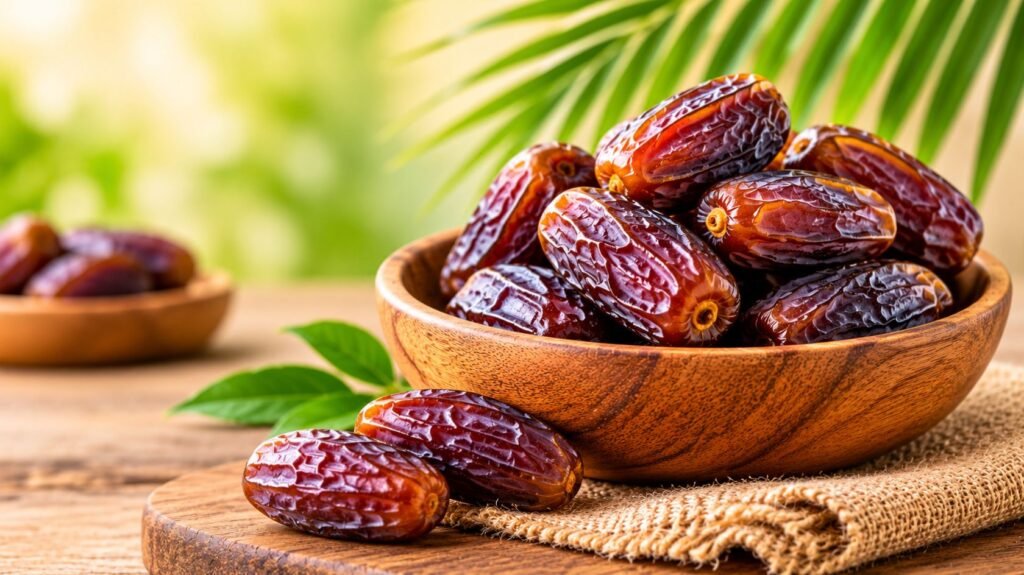
Ajwa dates are a variety of date palm fruit (Phoenix dactylifera) grown in and around Madinah, Saudi Arabia. A 2015 review in the International Journal of Molecular Sciences by Yasin and colleagues identifies Madinah and surrounding areas as the Ajwa variety’s place of origin. Ajwa dates are very dark brown to almost black, soft but slightly dry, and mildly sweet.
Ajwa is a small date: in human studies, seven dates weighed about 50 g in one trial and 60 to 80 g in another, or roughly 7 to 11 g per date, depending on the batch and grade. By comparison, USDA lists one pitted Medjool date at 24 g. Oasis Dry Fruits stocks two grades, Ajwa Dates and Ajwa Dates Premium, in its Ajwa dates collection.
Why Are Ajwa Dates Significant in Islam?
Ajwa dates are significant in Islam because of a hadith narrated by Sa’d ibn Abi Waqqas and recorded in Sahih al-Bukhari 5445. In the sunnah.com translation, the Prophet Muhammad (PBUH) said: “He who eats seven ‘Ajwa dates every morning, will not be affected by poison or magic on the day he eats them.” The same teaching appears in Sahih al-Bukhari 5769 and Sahih Muslim 2047.
Many Muslims eat seven Ajwa dates in the morning as a religious practice, and dates, including Ajwa, are traditionally eaten to break the fast during Ramadan. The hadith is a matter of faith. No scientific study has tested whether eating Ajwa dates prevents a person from being affected by poison or magic, and the research described below does not address it.
What Are the Health Benefits of Ajwa Dates?
The well-established health benefits of Ajwa dates are those shared by other date varieties: quick energy from natural sugars, dietary fibre and potassium. Research on Ajwa specifically is promising but early. Most studies are laboratory or animal experiments, and the human trials completed so far are small.
What Nutrients Do Ajwa Dates Provide?
Ajwa dates provide mainly carbohydrate in the form of natural sugars, with fibre, potassium and small amounts of protein and fat. USDA FoodData Central has no separate entry for Ajwa, so exact per-100 g figures for this variety are not available from USDA, and values in seller listings vary. Studies of date cultivars grown in Saudi Arabia report that sugar makes up 71 to 81% of the dry weight and potassium is the main mineral.
- Energy: dates provide a quick source of energy from natural glucose and fructose, which is one reason they are used to break a fast.
- Fibre: dates contain insoluble fibre, which adds bulk to the diet.
- Potassium: potassium is the main mineral in dates. USDA does not publish Ajwa-specific figures, so the amount in a serving of Ajwa is not confirmed.
- Sugar: the same sugars that supply energy mean portions matter, especially for people managing blood sugar or weight.
What Have Human Studies on Ajwa Found?
Two small randomised trials have tested Ajwa dates in people. The first, a 2015 cross-over trial at the University of Reading published in the British Journal of Nutrition, was registered on ClinicalTrials.gov (NCT02288611) with Ajwa dates as the intervention. The published paper describes the daily portion as seven dates, about 50 g, eaten for 21 days by 22 healthy adults. Stool frequency increased and stool ammonia fell, but the gut bacteria the researchers measured did not change significantly.
A 2022 randomised trial in Karachi, published in the Journal of King Saud University – Science, gave 26 adults with low HDL cholesterol 70 g of Ajwa each morning, five days a week, for six weeks, while 26 participants in the control group maintained their usual diet. In the Ajwa group, HDL rose by about 3 mg/dl and LDL fell by about 11 mg/dl, and the control group showed no significant change. The authors describe the trial as small and single-centre and call for larger studies.
The laboratory and animal research is broader. A 2017 review by Khalid and colleagues in Trends in Food Science & Technology summarises antioxidant and protective effects reported in preclinical studies of Ajwa fruit and seed, and states that quantitative studies are still needed to understand them. These results justify interest, not health claims. None of the trials was large enough to show that Ajwa prevents heart disease, cancer or diabetes, and Ajwa should not replace medicine prescribed for cholesterol or any other condition.
How Many Ajwa Dates Should You Eat a Day?
There is no official daily limit for Ajwa dates. The hadith specifies seven in the morning, which matches the portions used in the human trials, about 50 to 80 g for seven dates. USDA has no Ajwa entry, so any calorie figure for Ajwa is an approximation. Using the USDA figure of 282 kcal per 100 g for Deglet Noor dates as a stand-in, seven Ajwa dates weighing 50 to 80 g would provide roughly 140 to 225 kcal, and the actual figure depends on the size and moisture of the dates.
Count Ajwa dates as part of your daily food intake rather than as an extra. Pairing them with milk, yoghurt or nuts adds protein to the portion. People with diabetes, or anyone taking medicine for blood sugar, should ask a doctor or dietitian how many fit their plan.
How Are Ajwa Dates Eaten?
Ajwa dates are usually eaten whole, on their own, because their soft but slightly dry texture holds up without preparation. Common ways to eat them include:
- In the morning: seven dates, following the hadith.
- At iftar: to break the fast during Ramadan, often with water or milk.
- With nuts or milk: as a snack that adds protein to the portion.
- As a gift: during Ramadan and Eid. The Classic Gift Hamper includes a 250 g pack of Ajwa dates.
Ajwa dates keep best in an airtight container away from heat and humidity. Our guide to storing dry fruits compares refrigeration, pantry and freezer storage.
How Can You Tell Genuine Ajwa Dates From Imitations?
There is no reliable home test for genuine Ajwa, so buying from a seller who documents the origin is the safest approach. Ajwa’s price and religious value make mislabelling a risk, and dark colour alone proves nothing, because several date varieties are dark.
Before buying, check that:
- The pack or listing names Madinah, Saudi Arabia, as the origin.
- The pack shows the packer and importer details.
- The seller can share batch or import paperwork if you ask.
- The price is in line with other sellers offering the same grade.
These checks reduce the risk of buying mislabelled dates, but origin documentation does not guarantee authenticity, and none of the checks is a certified authentication method. Oasis Dry Fruits sells two Ajwa grades in 250 g and 500 g packs. Prices below are as listed on the Oasis Dry Fruits website in November 2026.
| Grade | 250 g | 500 g |
|---|---|---|
| Ajwa Dates | ₹400 | ₹775 |
| Ajwa Dates Premium | ₹450 | ₹875 |
For a comparison of Ajwa, Medjool and Kalmi dates, the guide to buying the best dates online in India covers texture, use and quality checks for each variety.
How Do Ajwa Dates Compare With Medjool Dates?
Ajwa and Medjool are different date varieties that differ most in size, origin and the reason people buy them. The table below compares them on attributes a buyer can check.
| Attribute | Ajwa | Medjool |
|---|---|---|
| Origin | Madinah region, Saudi Arabia | Traced to Morocco’s Tafilalet region; now grown in the US, Israel, Jordan and Mexico |
| Size | Small, about 7 to 11 g per date | Large, about 24 g per date (USDA) |
| Colour and texture | Very dark, soft but slightly dry | Brown, very soft and sticky |
| Main reason people buy it | Religious tradition | Size and sweetness |
| Oasis price, 250 g | ₹400 to ₹450 | ₹510 to ₹630 |
USDA provides detailed nutritional data for Medjool dates, but not for Ajwa dates, so Medjool is easier to track for calories. The nutrition facts for Medjool dates cover calories, sugar and portion sizes per date.
Frequently Asked Questions About Ajwa Dates
What do Ajwa dates taste like?
Ajwa dates taste mildly sweet, with a soft but slightly dry texture. They are less sticky than Medjool.
When is the best time to eat Ajwa dates?
Many Muslims eat Ajwa dates in the morning because the hadith in Sahih al-Bukhari 5445 refers to eating them every morning. No study has compared morning intake with other times of day for health effects, so outside religious practice, any time that fits your meals works.
Are Ajwa dates good for diabetes?
Ajwa dates can fit into a diabetes meal plan in small portions, but they are not a treatment for diabetes. They are high in natural sugar, and no large trial has tested Ajwa in people with diabetes. Ask your doctor or dietitian before eating them regularly.
Can you eat Ajwa date seeds?
Ajwa date seeds are not eaten whole. Ground seed powder has been tested in one small 2023 trial of 40 patients with high cholesterol, but that is not enough evidence to use it as a remedy. Ask a doctor before taking any seed powder product.
Why are Ajwa dates expensive?
Ajwa dates are expensive mainly because of their religious standing and their limited growing area. The 2015 review by Yasin and colleagues notes that Ajwa is highly prized because of its place in Islamic tradition and sells for about three times the price of the next leading date variety, and it identifies Madinah and surrounding areas as the variety’s origin.
Are Ajwa and Kalmi dates the same?
No. Ajwa and Kalmi are different varieties. Kalmi is a name used in the Indian market, and many sellers equate it with the Saudi Safawi variety, though trade names vary between sellers. Kalmi dates are longer and semi-dry, while Ajwa is smaller, rounder and darker.